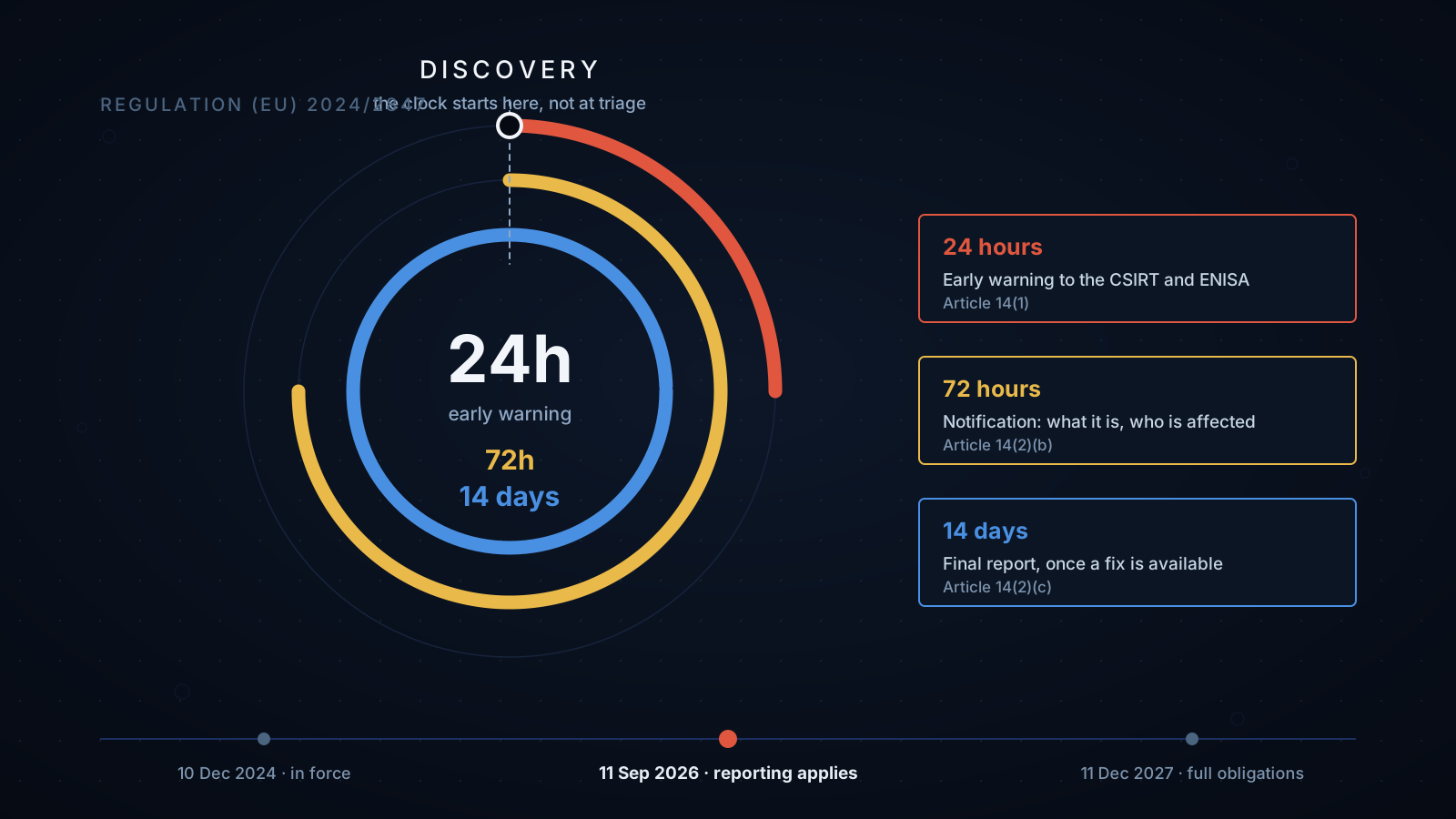
Regulation (EU) 2024/2847 — the Cyber Resilience Act — entered into force on 10 December 2024, and most of the industry filed it under "2027 problem". That filing was half right. The bulk of the essential requirements, the conformity assessment, and the CE marking do apply from 11 December 2027. But the reporting obligations in Article 14 were pulled forward deliberately, and they have applied since 11 September 2026.
The rest of the regulation improves products that have not been built yet. Article 14 is about products already in the field, being attacked today, whose users have no way of learning that they are exposed. Waiting three years to tell those users was indefensible.
First: does it apply to you?
The Cyber Resilience Act regulates products with digital elements placed on the EU market. Software you distribute is a product, and so are firmware and a connected device. A website is not, and neither is a software-as-a-service application in the ordinary case: services are governed by NIS2, not by the CRA. If your entire delivery model is a URL your customers visit, Article 14 does not reach you directly.
There are two ways that comfortable conclusion stops being true. The first is the remote data processing solution: where a hosted backend is necessary for a distributed product to perform its function, that backend is pulled into the product's scope. Ship a desktop client, a mobile app, or a device that will not work without your API, and your API is in scope with it. The second is being somebody else's dependency. A component integrated into a manufacturer's product is itself a product with digital elements, so a library, an SDK, or a self-hosted server distributed to customers carries the obligation regardless of how the vendor thinks of itself.
Free and open-source software developed outside commercial activity is excluded. Products already covered by sector regimes — medical devices, motor vehicles, civil aviation — stay under those regimes. Everything else that ships as software should assume it is in scope until someone has checked properly.
If you are a pure web application, Article 14 is not your obligation — but the question it asks is still your problem. NIS2 puts essential and important entities on the same 24-hour and 72-hour clock for significant incidents. The legal instrument differs. The engineering problem is identical.
The three deadlines
Article 14 defines two reporting tracks, each with three stages. One is triggered by a vulnerability in your product that is under active exploitation, rather than merely disclosed. The other is triggered by a severe incident affecting the security of the product. Both are reported through a single EU reporting platform to the CSIRT designated as coordinator and to ENISA. The stages below are the vulnerability track; the incident track runs to the same first two deadlines.
- Within 24 hours — the early warning
- A short notice that you are aware of an actively exploited vulnerability, and whether you know the Member States in which the product has been made available. It is deliberately small, because speed is the whole point of it. Nobody expects root cause analysis on the first day.
- Within 72 hours — the notification
- General information about the product and the vulnerability, the nature of the exploitation, and any corrective or mitigating measure taken or that users can take. This is where the question becomes technical: describing the nature of the exploitation means reconstructing what the attacker did, from whatever records you were already keeping.
- Within 14 days — the final report
- Due once a corrective or mitigating measure is available. It carries a description of the vulnerability including its severity and impact, information on any malicious actor identified, and the details of the fix. For severe incidents the equivalent final report is due within one month of the notification.
Separately, and running alongside all of the above, the manufacturer must inform the affected users about the vulnerability and, where appropriate, about the corrective measures they should apply. Notifying the regulator does not discharge the duty to your customers.
Discovery, not triage
The single most expensive misreading of Article 14 is about when the 24 hours begin. They begin when the manufacturer becomes aware of the active exploitation, which is earlier than every internal milestone you might mistake for the start: the security team's confirmation, a reproduction on a test system, the formal opening of an incident. Awareness is the trigger, and awareness includes the support ticket nobody escalated and the researcher email that sat in a shared inbox over a weekend.
This has a mundane consequence that matters more than most of the regulation: your intake path is part of your compliance posture. A published, monitored reporting channel with a stated acknowledgement window earns its place here: it puts a timestamp on "when did you become aware?", which is otherwise a matter of argument.
Why this is an architecture question
Twenty-four hours is enough time to write a paragraph, and far too little to build an evidence pipeline. Whatever you can say at hour 23 is whatever your system was already recording at hour zero, and the shape of that recording is decided by where state lives.
The 72-hour notification asks three things: what the vulnerability is, how it was exploited, and who was affected. In an architecture where the client holds state and the server accepts whatever the client asserts, those questions are answered from logs of the requests that arrived — which record the assertions, not the reasoning behind them. A tampered client sends a well-formed request. The log shows a well-formed request. Reconstructing intent from that means inference, and inference is slow.
In a server-authoritative system the same questions are queries. Every change to application state passes through the server, is validated there, and is appended to one log before it takes effect. That makes the audit trail the storage model rather than a feature somebody remembered to add, and it turns "which sessions performed this action, in this window" into a WHERE clause over a table that already exists.
-- Hour 2 of the 24: the blast radius, as a query.
SELECT session_id, type, occurred_at
FROM   events
WHERE  type = ?
AND    occurred_at BETWEEN ? AND ?
ORDER  BY occurred_at;
That is this site's own event table, unchanged. It is what an append-only server-owned log makes available by default. The 14-day final report asks for severity and impact; impact is a count over the same table.
The second architectural dividend is narrower but shows up in the same window: the size of the thing you must reason about. A product with no client-held state and two direct dependencies has a defect surface one engineer can hold in their head. Determining whether a disclosed vulnerability is reachable from your code is the first question of the 24 hours, and it is answerable in minutes with a dependency graph of ten modules and a call-graph scanner. It is a multi-day exercise across a thousand transitive packages.
Both of those are available before the clock starts, or they are not available at all. A property you want under pressure has to be a structural fact, because there is no time to acquire one once the pressure arrives.
What the architecture does not do
It does not decide that a vulnerability is being actively exploited. That is a judgement made by people, from evidence, and getting it wrong in either direction is costly: notify everything and the signal is worthless, notify nothing and the 24 hours expired days ago. No storage model makes that call.
It does not file the notification, maintain the software bill of materials the regulation requires, run the conformity assessment, or affix the CE marking. It does not give you a coordinated disclosure policy, a support period, or a vulnerability handling process — all of which Annex I Part II requires, all of which are documents and habits rather than code. It does not retain logs for you: an append-only table you truncate quarterly answers nothing about an intrusion discovered in month five.
What it does is remove the worst failure mode from the list of things that can happen to you on the first day: discovering that the answer does not exist. The deadline is short enough that querying a fact and reconstructing one land on opposite sides of the obligation. Where state lives decides which of the two you will be doing.
Penalties for breaching the essential requirements reach €15 million or 2.5% of worldwide annual turnover, which is the figure that gets the regulation read at all. The 24 hours is the part that sends people to look at their own logs, and that is the harder thing to arrange after the fact.